Showing posts with label Fish Tales. Show all posts

Friday, June 15, 2018

The Cedar Key School Tilapia Aquaculture/Aquaponics Project

I teach science in beautiful Cedar Key, Florida and pinch myself every workday ...

History lesson ...
I raised Tilapia back in the late 80's and early 90's ... when you actually had to explain what a "Tilapia" was to most folks.
Back then, I had to have a visit by an agent of the FLORIDA FRESHWATER FISH AND GAME COMISSION, now thankfully known as the FWC.

After an inspection to make sure my recirculating system would not allow the escape of this exotic species into the natural waters of Florida, I was granted a "Restricted Species" permit and allowed to proceed.

This process was repeated every time the permit expired... every 2 years I think.
Cumbersome.

Later in the early 2000's, when I wanted to grow Tilapia again, this time at Bronson High School where I taught science, I was told, " We really don't encourage small-scale Tilapia farming." by the FWC agent who came to inspect my INDOOR classroom recirculating system. He was so discouraging that I chose to grow the giant freshwater prawn, Macrobrachium rosenbergii instead.

All of this Tilapia restriction was really, really ticking me off as it was legal to possess them in the county just south of us, but not in our county. On top of that, the state, in the form of the University of Florida, had obviously allowed the release of Tilapia into Lake Alice on the UF campus. Any walk around the shoreline revealed huge Tilapia guarding nests.
Also, there was this fish kill there. 


This rant is almost over.
Recently the law changed and so did the attitude at the Aquaculture permitting offices. You can now legally possess blue tilapia in our region. Also, the state person I talked with on the phone before proceeding with our CKS Tilapia project was as encouraging and helpful as you could ever want.

So, there is some history here and you have just plowed through it.

The Cedar Key Tilapia Project:

Back in September 2017, I received 50 one inch long Tilapia fingerlings at Cedar Key School. They were placed into a 29-gallon aquarium to grow. We measured them as they grew and the kids learned a mix of biology topics and everyday problem-solving skills too.

I loved watching them collaborate, give, take, and finally come to a consensus on problems I tossed out to them.

Tilapia are jumpers and they needed a tank topper.

When I tasked the Marine Science class with building something to contain them, with no other guidance except... "You can use anything here in the Aquaculture lab, now go." ... they went for it. 


After some debate and brainstorming, they built a 3-part tank cover out of PVC, zip-ties, and clam bags that works perfectly. It has hinged sections so different parts can be opened separately, or the whole thing can be opened if needed.
None of that is on the state tests, but I firmly believe that life skills like cooperation and innovation should be part of any school year.

School's out now. 
 I drop in a couple times a week to feed them and check on the filters, etc.
At a feeding last week, I stuck my GoPro Hero 5 into the tank while the Tilapia were feeding.


The picture above shows the young Tilapia in a large nursery aquarium in the classroom. We had them for about a month at this point and they were really starting to grow.


Above, a nervous young Tilapia being weighed by students. 
(We zeroed out the scale with water and beaker on, then added the fish)

An early in the process data set from our measuring length and mass. 


Just before school was out, we moved a few Tilapia to different grow out tanks to distribute our risk. That net is 12 inches across.
In the new school year, these fish will be the nutrient source for our aquaponics system.

The kids grew these "all male" Tilapia from tiny fingerlings to eating size in one school year. Along the way, we lost one Tilapia who jumped out of the classroom tank and landed in the only empty bucket near the tank. Next to it were 3 buckets of tap water that had been set out overnight to dechlorinate. It was not his lucky day.

We also produced a few Tilapia judging by the tiny fry we found as we cleaned out our 250 gallon nursery tank at the end of the school year.

"Life will find a way."


Friday, July 28, 2017

The Best Fish,... Unless You're A Mosquito ... Then It's The Worst Fish.

Here is my favorite fish on the planet.
Gambusia Holbrooki, or just plain "Mosquito Fish".


So why... with over 27,000 species of fish, would anyone choose a small, not very colorful, freshwater minnow-sized fish as their favorite?

I was hoping you'd ask.
Pull up a chair and let's talk.

Let's get this out of the way first... Gambusia holbrooki are considered an invasive species in Australia, New Zealand, and even western North America.
In fact, they are exotic and potentially (almost assuredly) invasive in areas outside the mustardy region in the map below.

For clarity, "exotic" means you are a species outside of your native range ... like peanuts, apples, peaches, and oranges.
"Invasive" means you are exotic and you are causing problems in the region you have arrived in ... like burmese pythons, walking catfish, hydrilla, and retirees from up north.
US auto-generated map
Map From USGS
I just wanted to acknowledge the fact that yes, if you take a small, aggressive, super prolific fish out of its native habitat and plunk it into an exotic habitat like Australia, you are going to have problems.

We totally get that here in Florida.

I am lucky enough to live solidly in the native range of this awesome animal and I plunk them into every water bearing location at Pure Florida HQ.


If it routinely holds water, from ponds, outside turtle tank, aquaculture tanks, wetland plant beds, wildlife watering holes in the woods, ... they all get stocked with Gambusia.
Why? Because these tiny fish love mosquito larvae, aka "Wrigglers".
It works too. 
I live beyond most county mosquito control spraying (thank goodness) and the adult mosquito population here, even after a record breaking rainy summer is extremely low.
The reason is most of their children never become anything but Gambusia chow.

Here's a video I made on the kitchen table to demonstrate a Gambusia's appetite for wrigglers.

I dipped a single female Gambusia from my aquaculture tank and placed her in a very small tank on the kitchen table. I allowed her an hour or so to adjust to the strange new situation, and then I introduced 20-30 mosquito larvae.

She didn't stop until there were none left.
I'm sure that if I had added more wrigglers she would've nailed them too.

Like my Labrador Retriever "Bear", I'm not sure if these fish ever get "full".

On top of a relentless appetite for mosquito larvae, Gambusia also have this trick up their fins ... they breed like guppies, in fact, take a look at them... they even look like guppies without all the fancy colors.

They are live bearers, or more correctly, they are "ovoviviparous", which just means that after mating,(the males have a specialized pelvic fin that functions as a penis). the females keep the eggs inside of her until they hatch, and then they are expelled.

They can breed multiple times throughout the year if the conditions are good, so a few Gambusia can go a long way.

There you have it, my favorite fish out of over 27,000 species.
For eating the most dangerous insect on the planet and helping to control it WITHOUT pesticides that kill far more than just mosquitoes, my choice for BEST FISH EVER is the tiny Gambusia.

Teaser: There's another reason for this honor also, but that's another story.

Soon come.


Monday, July 06, 2015

PIPEFISH BABIES... NANOCUTENESS

 During the Seahorse Key Coastal Ecosystems Camp, we seined the seagrass many times and pipefish were a common catch.


Long and slender, like a seahorse stretched to its limits, the pipefish is wonderfully adapted to life in the undersea pastures of the  Big Bend Seagrass National Marine Preserve.


Don't be fooled by their "seahorsian" faces, they are voracious predators of all things tasty and tiny in the seagrass.

In the grass, they cling to the blades, and gently sway as the grass does, becoming, for all intents and purposes, just another blade of grass.

... Until tiny fish larvae, or other minuscule things swim close and then they strike with amazing speed.

If  amazing camo, body shape, and great predator skills were all pipefish had, ... that would be awesome enough, 
but  wait ...

This is an adult MALE pipefish with a couple hundred newborn "pipelings" that he has just birthed after being placed in the bucket.


If you are familiar with his close relative the seahorse, you already know that males of these two similar fish species carry the eggs in a ventral pouch until they hatch.


He's not really pregnant, the female produced the eggs, he's just incubating them in a relatively safe place.


During their courtship entanglement, the female laid her eggs in a groove near the pouch where they were fertilized and then sealed inside.

The evolutionary advantage in this strategy is that while he's incubating the current clutch of eggs, the female can get busy producing the next set.

This way, A LOT of baby pipefish enter the dangerous world of the ocean, increasing the odds that at least some of them will reach adulthood.


A tiny 2 day old pipefish.


Nanoperfection.


The adult and his young charges were all released after everyone in the camp had a chance to "ooh" and "awe" over them.

There was a lot of that.

I didn't "ooh", but I'm pretty sure I "awed".


Sunday, August 17, 2014

UNDERCAMP

A lot of fun happens topside at the camp.

For me, a lot of fun happens beneath the camp too.

Take this piling for instance.
This is one fun piling.
We'll come back to it later.

The Mangrove Snapper kids were having fun hanging out around the dead crab trap under the camp.
When you are a juvenile snapper, "fun" means eating without getting eaten.
 This is not a ghost trap that keeps on catching, it's torn open and is a popular refuge for the snapper clan.

I grew up calling these fish,  "Mango Snappers".
When they are big and move out to the deeper reefs, they go by "Grey Snappers" ... which is a pretty boring name compared to the other options.
And of course, whatever your village calls them they are known as "Lutjanus griseus" to science chimps around the world.

The old trap is becoming a micro artificial reef with lots of ways in and out. The hydrozoans and algae coating it provide habitat and food for a host of small invertebrates that attract the smaller fish upon which the juvenile snappers feed.
At night, when the sharks move in, it's a place to tuck your snappery butt in... and hope for the best.

Beneath the camp, shafts of light pound down around the edge, but in the center, it's dark and cozy.
The snapper appreciate this and react accordingly to threats or perceived threats like me.
In to the light when they feel safe, back into the shadows when they don't.
On this day I was bearing shrimp, so my threat level was low.

Here we are back at that fun piling I mentioned at the beginning of this little swim.
This piling has been here a long time. It sits apart from the camp ... oh, maybe 6 meters out from the lee side. It's basically a boat hitching post.

The oysters have colonized it and silently, slowly, shove each other aside as they jockey for the best plankton catching position.

The coolest things happen around this life-crusty piece of wood. The last time I was here in 2013, a giant southern stingray was lying next to it. At a meter across and sporting a 25 cm stinger, they impress by simply being.

On this swim, I pulled up to the piling to pause while Raymie and crew launched a boat to go off spearfishing at another location.
Once they pulled away and it was safe to resume snorkeling, the most amazing thing happened.

Out of the gloom, a large southern stingray cruised my way flanked by two legal (33 inches) Cobia.
Cobia look pretty sharkalicious, but they are a bony fish, not part of the cartilaginous clan... like the ray they were following.
They like like to hang with rays, since the rays often stir up food that the speedy Cobia can snatch up.
Cobia are awesome fish that fight powerfully on the line and taste wonderful on the plate.


The fish flotilla cruised right by me, just a few feet from the camp where the boys had tried their luck spearfishing earlier ... with minimal results... not because they can't shoot straight, just a lack of big fish worth spearing.


Pretty funny that this would happen as they headed off to a new hunting spot.

The pinfish were pretty stoked that I brought shrimp to the party AND that the Cobia kept going past the camp.
Pinfish swarm beneath the camp eating anything and everything that gets tossed over ... chunks of fruit, a bit of bread, that hotdog nobody ate, and of course any fishing bait you dangle over the side.
They even nibbled on the sea loosened skin around my barnacle scraped toes.
I'm thinking that when the time comes, I'd like my ashes mixed (you can wear gloves kids) with some fishmeal, flour, and enough water to make dough balls, and then feed them to these pinfish. 

I like the idea of that better than just a quick ash dump into the ocean.
And I owe the pinfish ... I've impaled many of them on a hook fishing for something bigger.

They are pretty efficient recyclers after all, and there's no need to lock up good nutrients.
Just sayin' ...
This toadfish was here every day, but hard to photograph up close, because when I dove down for a closer view, he backed into his hollow log every time.
Pretty awesome toad abode.


After awhile, even I get waterlogged ... actually, the sun was just too low to make photography possible ... and a pair of medium (too small!!) fins were making my size 11's howl.

Even so, leaving the water is always a little bittersweet.
I guess, I still miss my dorsal fin...and gills.


I love this place and am so grateful for the generosity of family and friends that makes days like this possible.


Saturday, April 05, 2014

Bluefin Killifish At Manatee Springs

Remember last week, when I had Manatee Springs all to myself?
Well, I wasn't totally alone ...

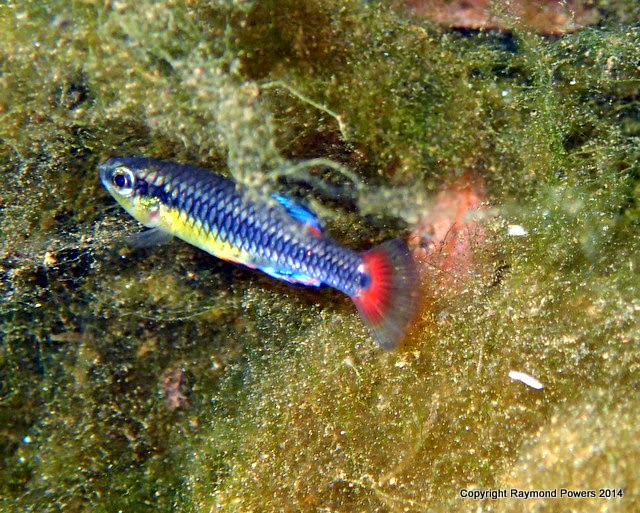
In the shadowy shallows that surround the main spring, beautiful Bluefin Killifish ( Lucania goodei) were feeling the tug of spring.
 

In the vegetated shallows, large schools were flitting about like fishy gems. Most seemed to be females, but scattered among the ladies were some awesomely decked out males, who were doing their best to convince the girls that they alone were worth their precious eggs.

Here's a sporty male killifish.
He turned out to be the only reasonably sharp male photo of the day.
(It was the first time using the Olympus Tough camera, so the fault is my ignorance, not the camera's quality.)

Even though the next photo doesn't meet the Pure Florida standard for sharpness or exposure, it does give a hint of how spectacular these males are when they are really showing off.
 

Yo baby!
Check me out!

I could float and watch these fish for hours, but at the time I had already spent about 2 hours underwater and the shallows were colder than the main spring depths on this chilly spring day.

So, reluctantly, I hauled myself out and left the bluefins to their wonderful courting rituals.
I will try and get back in there while they are all feeling so randy, and maybe, just maybe, put some better phishphotos up for you Pure Florida fans.


Monday, March 24, 2014

A FATHER AND SON DAY FISHING CEDAR KEY WITH CAPT. DENNY VOYLES

"Sunshine State"

This was our view as Captain Denny Voyles, my son Raymie, and I headed out into the Gulf and away from the Cedar Key boat harbor.

The view did not change during our entire voyage, a molten lead sea and a low heavy sky followed us everywhere on this day.
The dull monotone view gives no hint of the fantastic day of fishing that was in store for us.
There was nothing dull about that!

Here's the reason why.
Captain Denny Voyles is perhaps, the fishiest person in the Gulf of Mexico.
I have fished with him for about 20 years, even before he became a licensed guide and ... well, it's uncanny folks... the man can find fish on any day of the year under any weather conditions.

I've never seen anything like it.

If this part sounds a little like an advertisement, it's only because I wish you ALL could spend a day on the Gulf with Capt. Denny.
(And you can of course if you contact Voyles Guide Service)
You won't regret it.


Here's the reason for this particular trip.
My boy.
He's a hard working, bartending , about to graduate from UF ...probably with a 4.0 or close to it GPA, about to go to Law School kind of guy that's pretty busy on the average day.

So when he called me last Friday and said, "Hey Dad, you want to go kayak fishing at Shell Mound on Sunday?", I of course said yes.

Just my luck, Captain Denny was in earshot, and he said, "Hey, why don't you guys come with me on a REAL boat."

Well, I wasn't about to turn that offer down, so when Raymie showed up early Sunday morning, we left the kayak and canoe home for another day.


Two lucky guys.


Raymie with a nice keeper spotted seatrout.
He turned out to be the "trout whisperer" on this outing and caught the most trout.
We fished multiple spots, moving when the bite slowed, sometimes only a few hundred yards was all it took to get on them again.

All of the trout we caught were heavily muscled, healthy, and beautifully colored.
They were pretty cooperative and we released many almost legals unharmed to grow up, even while hitting our limit of keepers for supper.


Becky the seadog came along on this buddy trip. She was a little under the weather on this day, but such a sweet dog.

Denny caught this dogfish shark, which amazed me since I always think of dogfish as a deep water, more northerly variety of shark ... we were fishing in about 6 feet of water on the flats at the time.
This girl was fat with pups, so we posed just long enough for a photo and back she went.
I think she was in shallow to birth those shark pups in the safety of the seagrass beds.
(Julie Zickefoose, that shot is for you)


The fish box became more crowded as the day went on. Most of the fish are Spotted Seatrout, but the darker banded fish are Sheephead.

A tiny top secret bit of bottom structure held the s
Sheephead around it and we "worked" hard to trick those 4 keepers into the boat.

The trick with Sheephead is, "Set the hook just BEFORE they bite."

Tricky, no?

When we finally decided that the sea had given us more than enough food and fun for one day, we headed back in to Cedar Key.
At the dock, the pterodactyls  ... pelicans were waiting for us.

Captain Denny made short work of the fish filleting, which left me with nothing to do, but wander around taking pictures like a tourist.
I can do that.

We ate our fish a few hours later at home and they were fantastic!
I blackened some and southern fried the rest.
I didn't hear any complaints from the diners.

The photo above, of Denny, is the one moment in this awesome day that the clouds parted, blue sky appeared, and the sun shone brightly.

Funny.

Thanks Captain Denny for a great day on the water with my boy.


One last thing ... NEVER get into a staring contest with a pterodactyl pelican ... You'll lose.


Wednesday, February 12, 2014

Reassuring The Nervous Goldfish Of Bag Number 3


Dear Nervous Goldfish In Bag Number 3,
Welcome.
We are happy to have you as part of our Cedar Key Aquaponic system.
 
I know by now, you've heardof the sad misfortune that befell both Goldfish Bag Number 1 and Goldfish Bag Number 2.
Please know, in your simple 2-chambered heart,  that I am taking all precautions to ensure that you, my 15 cent friends, make it safely into the 150 gallon aquaponic fish tank at Cedar Key School.
 
It saddens me to think of poor Bag Number 1.

How excited they were to be dipped from the crowded feeder fish tanks at Petsmart.
 
Like you, they heard me tell the Petsmart sales associate,
" Pick out some lively, healthy ones, these fish are not going to feed some oversized Oscar. They get to live a long healthy life making poo for my school aquaponic system".
 
You see Bag Number 3, the plants in the aquaponic system need your poo to thrive and you need clean water to thrive. We send your pooish water to the plant beds, they slurp up the poo, grow abundantly, and depooed water splashes back down to you.
 
It's a beautiful thing.


When I asked my students to move all the hungry bluegills from the aquaponic tank, it never occurred to me to check behind them. They are so capable.

Rest assured Bag Number 3, I NEVER would have released the crew of Bag Number 1 into that tank on that fateful Friday if I even suspected danger lurking below.

I can still hear the twenty tiny splashes as the goldfish of Bag Number 1 plopped happily into their new home.
Those splashes ... they haunt me.
 
Who knew the kids would miss not just any bluegill, but the saucer-sized, hungriest bluegill in the school.
 
 
Oh it was a mournful Monday when we went to check on Bag Number 1's status. Although we peered intently, our noses touching the surface water, no gold fish were visible, only an overstuffed bluegill of epic proportions.
 
Alas, poor Bag Number 1 ... we wanted them to make poo NOT become poo!
 
Still, we gathered ourselves up and resolved to try again ...to honor the brave crew of Bag Number 1... and to make more poo of course.
 
Bag Number 2 ... sigh ... their story will ring familiar, but the blame here is my own, and yes, another bluegill is involved.
 
A few weeks after the Bag Number 1 debacle, I returned to Petsmart for 20 more lucky to NOT BE "feeder fish" for our system. As it was a weekend, I decided to "park" the crew of Bag Number 2 in my garden pond, an old livestock tank with iris, anacharis, and a few minnows. I had removed the last bluegill in a drawdown some 2 months before.
 
As before, the crew of Bag Number 2 splashed joyfully into the livestock tank "pond". I watched them for awhile as they explored the new tank, glinting in the Florida sun and finding their way among the many aquatic plants there.
 
A few days later, a casual glance revealed no goldfish in the garden tank pond. Bright orange fish, clear water, a dark green background ... some of Bag Number 2 should have been visible, but no ...
 
And then I saw him. Lurking beneath a lily pad, a bluegill of about 6 chubby inches.
How did I miss that fellow? A few months before, I had drained that pond to a few inches and removed all (I thought) the larger fish.
 
Not a single member of Bag Number 2 survived my mistake.
 
So, dear members of Bag Number 3, I understand your nervousness.
 
I assure you that my students and I have checked and double-checked the aquaponics tank ...and we will check it one more time before you splash down tomorrow.
 
Third time's the charm.


Saturday, November 09, 2013

CRAWFEEEESH !

The official Crawfish checklist for Florida shows 57 species of native and introduced species. Not sure which one this is, but I know this ...
These guys and gals went from tiny one inchers to full grown adults over the past year as they hung out in my old Tilapia tank. The tank is my catch all for anything interesting that comes up in my dip net.
Currently it's almost empty except for two giant prawn survivors, a couple of bream, and some snails.

I love crustaceans. They are so spunky and a little comical with the expressive stalked eyes, whiskery appendages, and feisty attitudes.
This one looks like he's rolling up his sleeves, getting ready for a scrap.

Apparently, they all felt comfortable enough in the Tilapia tank to do a little spermatophore passing, 'cause this little girl is pregnant. She will carry this precious cargo on her swimmerettes, safely tucked under her abdomen until the time is right.

After hatching the tiny, perfect crawfishlings will cling to her for a wee bit before letting go and taking their chances as small, delicious fish food.

These crawfish were moved to my Anacharis filled garden livestock tank pond where they can live pretty normal crawfish lives and where their babies will have tons of cover to hide in.

That beats a pot of seasoned boiling water any day ... IF you are the crawfish.

Saturday, September 21, 2013

I Love It When A Shark Interrupts My Teaching.

Only at Cedar Key School would your lesson be interrupted by a shark swimming between you and your students.

My Marine Science class and I walked down to the nearby shore Friday, to catch a few critters for their saltwater aquariums. As we waded in, this small bonnet head shark cruised between and around us, hunting the abundant blue crabs that scurried around our feet.

Yes, it was awesome.

Monday, February 25, 2013

TINY HOST AND TINY PARASITE POST

This is a "hogchoker", a common fish of Florida's freshwater streams and springs.
They lie on the bottom which they match by adjusting their own pigmentation, so you probably won't ever see one unless you do a lot of snorkeling in Florida springs or spring runs.

Hogchokers are members of the flounder clan, but don't get too excited, they are a tiny species and a 5 incher is HUGE!

The Hogchoker in this post is only about 5 to 7 cm long.


Look close at the right side of the picture.

See the tiny red leech attached to the Hogchoker's fin?

Here is a very cropped view of the same Hogchoker photo.
I assume the baby leech just lunched on the contents of tiny capillaries in the fins of he Hogchoker.


This is the same leech pup on the distal end of my index finger.

I've seen a lot of leeches in a life time of mucking about in swamps, dip netting, and peeking into turtle armpits, but NEVER have I seen one this tiny.

Leeches always make me think of "Stand By Me", the movie based on Stephen King's story, "The Body".

A few years back, when I almost completely severed the tip of my ring finger while scalloping in the Gulf, I had high hopes that the Docs might use a medicinal leech or two to ensure blood flow to the reattached finger tip.

Alas, they did not.

Story opportunity missed.