Showing posts with label Fish Whisperer. Show all posts

Friday, June 15, 2018

The Cedar Key School Tilapia Aquaculture/Aquaponics Project

I teach science in beautiful Cedar Key, Florida and pinch myself every workday ...

History lesson ...
I raised Tilapia back in the late 80's and early 90's ... when you actually had to explain what a "Tilapia" was to most folks.
Back then, I had to have a visit by an agent of the FLORIDA FRESHWATER FISH AND GAME COMISSION, now thankfully known as the FWC.

After an inspection to make sure my recirculating system would not allow the escape of this exotic species into the natural waters of Florida, I was granted a "Restricted Species" permit and allowed to proceed.

This process was repeated every time the permit expired... every 2 years I think.
Cumbersome.

Later in the early 2000's, when I wanted to grow Tilapia again, this time at Bronson High School where I taught science, I was told, " We really don't encourage small-scale Tilapia farming." by the FWC agent who came to inspect my INDOOR classroom recirculating system. He was so discouraging that I chose to grow the giant freshwater prawn, Macrobrachium rosenbergii instead.

All of this Tilapia restriction was really, really ticking me off as it was legal to possess them in the county just south of us, but not in our county. On top of that, the state, in the form of the University of Florida, had obviously allowed the release of Tilapia into Lake Alice on the UF campus. Any walk around the shoreline revealed huge Tilapia guarding nests.
Also, there was this fish kill there. 


This rant is almost over.
Recently the law changed and so did the attitude at the Aquaculture permitting offices. You can now legally possess blue tilapia in our region. Also, the state person I talked with on the phone before proceeding with our CKS Tilapia project was as encouraging and helpful as you could ever want.

So, there is some history here and you have just plowed through it.

The Cedar Key Tilapia Project:

Back in September 2017, I received 50 one inch long Tilapia fingerlings at Cedar Key School. They were placed into a 29-gallon aquarium to grow. We measured them as they grew and the kids learned a mix of biology topics and everyday problem-solving skills too.

I loved watching them collaborate, give, take, and finally come to a consensus on problems I tossed out to them.

Tilapia are jumpers and they needed a tank topper.

When I tasked the Marine Science class with building something to contain them, with no other guidance except... "You can use anything here in the Aquaculture lab, now go." ... they went for it. 


After some debate and brainstorming, they built a 3-part tank cover out of PVC, zip-ties, and clam bags that works perfectly. It has hinged sections so different parts can be opened separately, or the whole thing can be opened if needed.
None of that is on the state tests, but I firmly believe that life skills like cooperation and innovation should be part of any school year.

School's out now. 
 I drop in a couple times a week to feed them and check on the filters, etc.
At a feeding last week, I stuck my GoPro Hero 5 into the tank while the Tilapia were feeding.


The picture above shows the young Tilapia in a large nursery aquarium in the classroom. We had them for about a month at this point and they were really starting to grow.


Above, a nervous young Tilapia being weighed by students. 
(We zeroed out the scale with water and beaker on, then added the fish)

An early in the process data set from our measuring length and mass. 


Just before school was out, we moved a few Tilapia to different grow out tanks to distribute our risk. That net is 12 inches across.
In the new school year, these fish will be the nutrient source for our aquaponics system.

The kids grew these "all male" Tilapia from tiny fingerlings to eating size in one school year. Along the way, we lost one Tilapia who jumped out of the classroom tank and landed in the only empty bucket near the tank. Next to it were 3 buckets of tap water that had been set out overnight to dechlorinate. It was not his lucky day.

We also produced a few Tilapia judging by the tiny fry we found as we cleaned out our 250 gallon nursery tank at the end of the school year.

"Life will find a way."


Sunday, August 17, 2014

UNDERCAMP

A lot of fun happens topside at the camp.

For me, a lot of fun happens beneath the camp too.

Take this piling for instance.
This is one fun piling.
We'll come back to it later.

The Mangrove Snapper kids were having fun hanging out around the dead crab trap under the camp.
When you are a juvenile snapper, "fun" means eating without getting eaten.
 This is not a ghost trap that keeps on catching, it's torn open and is a popular refuge for the snapper clan.

I grew up calling these fish,  "Mango Snappers".
When they are big and move out to the deeper reefs, they go by "Grey Snappers" ... which is a pretty boring name compared to the other options.
And of course, whatever your village calls them they are known as "Lutjanus griseus" to science chimps around the world.

The old trap is becoming a micro artificial reef with lots of ways in and out. The hydrozoans and algae coating it provide habitat and food for a host of small invertebrates that attract the smaller fish upon which the juvenile snappers feed.
At night, when the sharks move in, it's a place to tuck your snappery butt in... and hope for the best.

Beneath the camp, shafts of light pound down around the edge, but in the center, it's dark and cozy.
The snapper appreciate this and react accordingly to threats or perceived threats like me.
In to the light when they feel safe, back into the shadows when they don't.
On this day I was bearing shrimp, so my threat level was low.

Here we are back at that fun piling I mentioned at the beginning of this little swim.
This piling has been here a long time. It sits apart from the camp ... oh, maybe 6 meters out from the lee side. It's basically a boat hitching post.

The oysters have colonized it and silently, slowly, shove each other aside as they jockey for the best plankton catching position.

The coolest things happen around this life-crusty piece of wood. The last time I was here in 2013, a giant southern stingray was lying next to it. At a meter across and sporting a 25 cm stinger, they impress by simply being.

On this swim, I pulled up to the piling to pause while Raymie and crew launched a boat to go off spearfishing at another location.
Once they pulled away and it was safe to resume snorkeling, the most amazing thing happened.

Out of the gloom, a large southern stingray cruised my way flanked by two legal (33 inches) Cobia.
Cobia look pretty sharkalicious, but they are a bony fish, not part of the cartilaginous clan... like the ray they were following.
They like like to hang with rays, since the rays often stir up food that the speedy Cobia can snatch up.
Cobia are awesome fish that fight powerfully on the line and taste wonderful on the plate.


The fish flotilla cruised right by me, just a few feet from the camp where the boys had tried their luck spearfishing earlier ... with minimal results... not because they can't shoot straight, just a lack of big fish worth spearing.


Pretty funny that this would happen as they headed off to a new hunting spot.

The pinfish were pretty stoked that I brought shrimp to the party AND that the Cobia kept going past the camp.
Pinfish swarm beneath the camp eating anything and everything that gets tossed over ... chunks of fruit, a bit of bread, that hotdog nobody ate, and of course any fishing bait you dangle over the side.
They even nibbled on the sea loosened skin around my barnacle scraped toes.
I'm thinking that when the time comes, I'd like my ashes mixed (you can wear gloves kids) with some fishmeal, flour, and enough water to make dough balls, and then feed them to these pinfish. 

I like the idea of that better than just a quick ash dump into the ocean.
And I owe the pinfish ... I've impaled many of them on a hook fishing for something bigger.

They are pretty efficient recyclers after all, and there's no need to lock up good nutrients.
Just sayin' ...
This toadfish was here every day, but hard to photograph up close, because when I dove down for a closer view, he backed into his hollow log every time.
Pretty awesome toad abode.


After awhile, even I get waterlogged ... actually, the sun was just too low to make photography possible ... and a pair of medium (too small!!) fins were making my size 11's howl.

Even so, leaving the water is always a little bittersweet.
I guess, I still miss my dorsal fin...and gills.


I love this place and am so grateful for the generosity of family and friends that makes days like this possible.


Saturday, April 05, 2014

Bluefin Killifish At Manatee Springs

Remember last week, when I had Manatee Springs all to myself?
Well, I wasn't totally alone ...

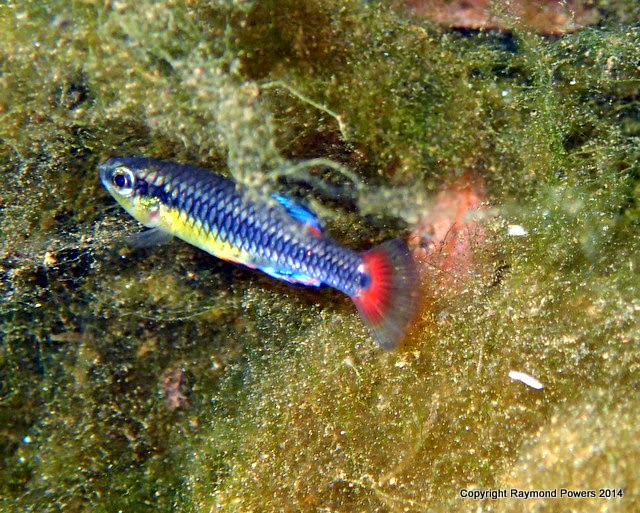
In the shadowy shallows that surround the main spring, beautiful Bluefin Killifish ( Lucania goodei) were feeling the tug of spring.
 

In the vegetated shallows, large schools were flitting about like fishy gems. Most seemed to be females, but scattered among the ladies were some awesomely decked out males, who were doing their best to convince the girls that they alone were worth their precious eggs.

Here's a sporty male killifish.
He turned out to be the only reasonably sharp male photo of the day.
(It was the first time using the Olympus Tough camera, so the fault is my ignorance, not the camera's quality.)

Even though the next photo doesn't meet the Pure Florida standard for sharpness or exposure, it does give a hint of how spectacular these males are when they are really showing off.
 

Yo baby!
Check me out!

I could float and watch these fish for hours, but at the time I had already spent about 2 hours underwater and the shallows were colder than the main spring depths on this chilly spring day.

So, reluctantly, I hauled myself out and left the bluefins to their wonderful courting rituals.
I will try and get back in there while they are all feeling so randy, and maybe, just maybe, put some better phishphotos up for you Pure Florida fans.


Saturday, September 21, 2013

I Love It When A Shark Interrupts My Teaching.

Only at Cedar Key School would your lesson be interrupted by a shark swimming between you and your students.

My Marine Science class and I walked down to the nearby shore Friday, to catch a few critters for their saltwater aquariums. As we waded in, this small bonnet head shark cruised between and around us, hunting the abundant blue crabs that scurried around our feet.

Yes, it was awesome.

Monday, January 21, 2013

GoPro Fish TrapCam : 25 Feet Below The Gulf

Last week, while fishing with my my friend Capt. Denny, I had a bout of inspiration.
On board was a small pinfish trap that we had brought along in hopes of catching something small, but neat for my daughter's classroom aquarium.
Also on board was my ever present GoPro Hero camera.

I stopped catching black seabass for a moment, borrowed a ziptie from Denny, and in a flash, TRAPCAM was born.
With the GoPro ziptied to the inside top of the trap and facing the bait box, we lowered my precious baby to the rocky bottom 25 feet below.

We soaked the TRAPCAM three times while we continued to fish. Each soak was about 20 minutes.
I have uploaded two of the videos to my YouTube account (Natcoast's channel).

They are longer than the usual video here, but soothing in a "watching fish and listening to a live healthy crackling sea" sorta way.

For those of you who want just the highlights, I jotted down a few times when major events happen. The site is a patch of limestone rock that offers some relief to an otherwise flat sandy bottom . It was a plankton rich day, so throughout the video tiny specks of life drift across the view.
The seabass and grunts find the trap just a moment or two after it hits bottom. Later, a moray eel (honeycomb moray) shows up and joins the feeding frenzy.

Here is a time line for those of you who are short on time or just impatient.
  • 51s - Touchdown on the bottom.
  • 2:28- First fish in the trap.
  • 6:11- Black sea bass stares into camera.
  • 11:23 - Haul up to check tank.
  • 11:50 - Drop trap back down.
  • 12:16 -  Touchdown number 2.
  • 12:27 - Moray swims by in the background.
  • 12:49 - Moray approaches trap.
  • 14:46 - Moray enters trap.
  • 1530: - Chomp! Black Sea Bass bites camera.
  • 15:51 - Moray up front.
  • 16:26 - Sea Bass bumps camera.
  • 17:47 -  Grunts at the door.
  • 20:37 - Lift off and return to surface.
The crackling and popping soundtrack is simply ocean background noise, much of it provided by shrimps and other invertebrates.

The abundance of fish in the video, both around the trap and passing in the background, is pretty awesome. That is due entirely to the presence of the rocks which provide valuable hard substrate real estate for all of the sessile organisms that need a hard surface upon which to attach and grow.
The sponges, soft corals, barnacles, and oysters that attach to the rocks not only provide food for predators, but they also become part of the structure ... literally part of the habitat.

All of the fish in the trap were released except for one moray, a sand perch, and a sea bass that now reside in our Cedar Key Marine Science Lab.

Enjoy!


Thursday, March 22, 2012

MANATEE MULLET MAGIC


I finally sat down and installed my Blurfix attachment to my GoPro camera housing. Wednesday, I took it to Manatee Springs State Park for a pressure test in the main spring bowl ... about 25 feet deep.

After a few deep dives with an empty case and  no leaks, I returned to the surface and popped the GoPro into the housing.

Then it was back into the water.

I cruised around filming the fish and scenery for an hour or so, hoping that the Blurfix truly had fixed the slight underwater blur that plagues the standard GoPro housing.

A school of large mullet were extremely cooperative, and I think you regulars may notice how much sharper the focus is.
If you want to compare, you could go back a few posts to the last Manatee video post and compare the sharpness.

I'm stoked and looking forward to getting it wet over spring break.

In case you are wondering about mullet in pure fresh spring water, they are "euryhaline" and can handle both salty and fresh water ... just like bull sharks ... which I did not see in Manatee, ... but ... it's not impossible.

Stay wet y'all.

Saturday, February 26, 2011

Stingray Chatter


Oops.
You are not a redfish.


No, I am not. Now would you please remove your stinger from my snout?

Sorry, I was hoping for a redfish.

YOU were hoping for a redfish? Yet, you let your bait soak on the bottom, still, and lifeless?

I was eating a sandwich ... sorry, Mr. Cranky.

Mr. Cranky? Yes, I suppose I am a wee bit cranky ...MAYBE IT'S BECAUSE YOUR STRANGE CURVED STINGER IS STUCK IN MY LIP?!!!

Oh yeah, hang on a sec, I'm going to have to hoist you up here into the air for a moment to extract that. I promise to release you ASAP.

I'm going into the ice chest, aren't I? This is it for me ... dang ... it's mating season ... just my luck.


No, really. I promise I will let you go. Just come on aboard for a moment.

OMG! WHAT ARE YOU DOING NOW?

Chill dude, I just want to take a few pictures of your "privates" to post on the internet.

WHAT? WHAT DID YOU SAY?

Relax. It's just for educational purposes. I want the PF readers to know a boy stingray when they see one.

Well ... okay then, but make it quick.

Done. Now roll over ...

OMG.


Hold still, I just need a shot of your stinger.
And DO not whip that into my flesh.
Been there, done that and it makes me very angry ... and you wouldn't like me when I'm angry.
Bad things happen to stingrays who sting me.
You get my point?

Okay, Okay, but let's get this over with ... my mouth's a little dry.


All done, back you go.

They are never going to believe this down at the oyster bar.

Postscript:

That's pretty much how it went. Stingrays can be pretty talkative as fish go.

If you go back up to the picture of his white ventral side, those long extensions are claspers. Male sharks and rays use claspers to mate internally. A groove in the clasper transfers sperm into the female.

The sharks and rays are about the easiest fish to sex due to the very obvious claspers on males.

The stinger shot is a little soft. Sorry. I was hurrying since the poor thing was out of the water and forgot to push macro. It's a serrated modified scale with venom glands.

... HURTS like ... well, I'm not allowed to say on this family safe blog. It's pretty incredible though, very impressive, unforgetable, and way more OUCHIFUL than catfish pokes.

If you noticed the hole in his head behind the eye, ... that beautiful sharky eye, ... the hole is a "spiracle".

It's a way of getting water to your gills when your mouth is usually against the muddy bottom.

Very clever.

If you choose to handle one, keep your hands and body away from the pointy end.