Showing posts with label Rodman. Show all posts

Friday, March 11, 2016

RODMAN RESERVOIR, PART 3 ... Crushing it.


The last time we talked, I was paddling through the stump forest in the historic Oklawaha River channel. 
A cyclic drawdown of the large and artificial Rodman Reservoir had exposed both the old river path and the stumps of a forest long gone.

The machine in the photo above (a photo from Google images) is "The Crusher"... or "The Monster" ... 300 tons of forest smashing steel. It was much bigger than it appears in that distant photo. On Google, there is a photo of a girl standing at the foot of it for scale ... go seek it out.

The machine was built for the express purpose of both knocking down the river floodplain forest and smashing the trees into the ground so securely that they would just stay there and rot when Rodman was flooded by the dam.

Plans look so sparkly on a drawing board, don't they?

Once the forest was flattened and the river backed up behind the new dam, the trees began popping up until Rodman Reservoir was a minefield of floating logs.

This made boating in the reservoir a risky proposition for a long time and even today, logs still create navigation challenges.


So, while on one side of the barge canal, the ghost forest exists as vertical, broken, but still rooted stumps like we've seen in the earlier posts, ...on the other side all the trees are angled or horizontal.

Even with 7 more feet of water above this area at "full pool", plenty of these logs could be an issue for motorized boats.

Rodman is also heavy with exotic, invasive aquatic plants like hydrilla, and water hyacinths among the Crusher smashed logs.
They contribute vast amounts of organic matter to the reservoir which creates much of the black muck on the bottom.

But what about this strange crushed side of the canal?

The flattened side of the barge canal was very shallow due to the drawdown so even in a kayak, I found myself constantly steering around submerged logs, hyacinth clogs, and dead ends.


There were beaucoup grackles perching, flitting, and hunting "things" down among the floating hyacinths.
I know they're just grackles, but I like their personality and sleekness.
They were good company.
I'm a fan of anhingas too and this one let me drift pretty close before lifting off.


The crushed forest.


Looking out over it, I pause and drain the water with my imagination, let ... or better yet ... help the forest come back with some good restoration plans, and imagine ahead a hundred years to a restored Oklawaha with a maturing forest where now there are only dead stumps.


I'm not sure the long view is very popular right now in an era of instant gratification and over development. 
I know this, we would have no Yellowstone or Everglades today if folks in the past had not taken the long term view long ago.
Folks in the late 1800's, fighting to establish National Parks ... they were thinking of me before my grandparents were born.
Question is ... do we still do that?

Thing is, I don't want my future great-grandchildren to see the lower Oklawaha like it is now with an artificial eutrophying Rodman Reservoir.

I want them to see the springs buried beneath this artificial lake and a mature cypress forest outlining the curving path of the Oklawaha River.

And yeah, they may have to work a little harder to catch a big bass than anglers in Rodman do today.
Fish in a river are not a captive audience.
I'm okay with that.

There will still be plenty of fish with a free river, as there is today in the flowing Oklawaha upstream from Rodman.

And there will still be awesome critters like the banded watersnake below.

He kept popping up to breathe while I was parked, imagining the dam gone and the river system restoring itself.


The first time he popped up, I thought, "Dang it, I missed him!"

I sat for a bit, and in a minute or two he popped up again ... and I missed him again.
So, I let the kayak drift a little closer to the sunken log that he seemed to be working for crayfish or other tasties.

And ... Bazinga!
There he was.
Gotcha!

I like this last photo of episode 3, because it's a nice little sandwich of the crushed forest bog clog side, the barge canal with a bass boat zooming through, the stump forest on the Oklawaha channel side, and, last but not least, the upland forest beyond.

In the final episode of Rodman Exposed, I chase the Eagle.

Sunday, March 06, 2016

RODMAN DRAWDOWN PART 2: Life Among The Dead.

So, if I remember correctly, the last time we chatted here, we were kayaking around Rodman Reservoir during the most recent drawdown.
This photo is what drawdowns are all about ... exposing the mucky bottom to the air and Sun to reduce the black, gooey, organic muck that builds up in lakes over time. 
The lake bottom above will soon be under about 7 feet of water when the drawdown is over and Rodman is allowed to refill.

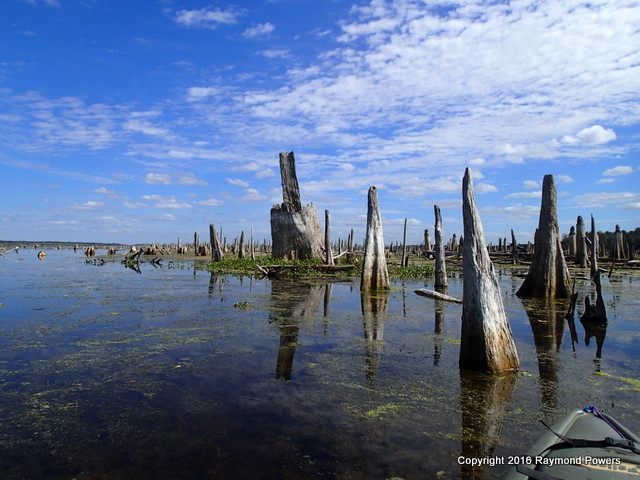
Flat featureless lake bottom is not all that interesting or rich in critters of the macro kind, so I turned my kayak towards the dead forest. The water here was alive with small fish, the logs loaded with birds, and the shallow depth and submerged logs kept the high powered bass boats out in the old barge channel and beyond.

Pretty kayakalicious.


These ibis found one of the gajillion log islands a good place for a preen in the warm sun. The strip of blue water in the right background is the barge canal. The water where I am at that moment is about 1 foot deep or less and clogged with logs.
Sort of a log-clog.

If the lake has been drawn down the full 7 feet described on the FWC website, a lot of these stumps would be almost fully submerged at full pool... a fact that makes Rodman a pretty robust largemouth bass fishery.

The excellent fishing available at Rodman is one of the arguments for keeping the dam and the reservoir.


I love fishing, but I disagree with this viewpoint.
I don't think that fact trumps outweighs the value of restoring a wild river and the original ecosystem of the Oklawaha.
There will still be fish.


This kayak voyage and this dead forest was very nostalgic for me.
Back in 1975, as a 17 year old, my buddy Kevin and I replicated a canoe trip that my big brother Terry had done a few years before.
Our goal was to paddle the Oklawaha from its headwaters to its mouth at the St. Johns River. I posted about this on Pure Florida in 2008, but a bunch of you weren't paying attention back then.

In 1975, Rodman Dam and the reservoir were only about 7 years old and these cypress stumps and broken trunks that appear in this post were still very tall, mostly intact dead trees.
I remember their height distinctly thanks to the terrific lightning storm that was exploding around Kevin and I as we semi-desperately paddled our asses off in the submerged Oklawaha channel. It was the tall, dead, lightning-hungry forest on either side of us that kept us in the river and not lost among the drowned forest.

Somehow that evening, the lightning chose trees away from our immediate location ... or maybe we were just paddling lightning fast via the power of adrenalin.

Now, decades of Florida weather have shortened these trees to nothing more than tall stumps.

Stumps that offer pretty good hunting grounds for wading birds of all kinds.


A Snowy Egret hunting Gambusia minnows among the logs. Gambusia were everywhere in these shallows.


Not the world's greatest Gambusia (aka "Mosquito Fish") photograph, but I did snag one of the mutant males in the shot. These black and white fish were easy to spot and there were a lot of them. It's a mutation that only shows in the males. One study I read showed a slight survival advantage for the speckled males over the silver "normal" males when faced with their usual predators such as bass, crayfish, and dragonfly nymphs.
They seem like a beacon to wading birds to me though.


 Ibis among the dead.
The wading birds also walk around on the mats of green vegetation (hyacinths, pennywort, hydrilla) while they hunt.
You would think there would be an alligator around every corner, but I only saw 2 the entire day.
Of course it was a warm spring day, and a work day, not a basking day for gators.

This little blue let me get only so close before launching.


This stump was one of the giants that were sprinkled among the other tree skeletons. I realize there's no size reference here, but if you look at the big groove on the left side, between the buttresses ... I fit in there.
I know this, because I pulled the kayak up as close as I could and log hopped to that stump ...and then I climbed up the side and look into it's hollow interior.
Yes I did!
I have the GoPro video to prove it.
Later.

Maybe it's the teenage rebel in me, but when I look at this stump, I see the forest giving the finger to the Army Corps of Engineers and the Barge Canal project.

Next Rodman episode: "Big Charlie The Tree Crusher"


Sunday, February 28, 2016

Rodman Reservoir EXPOSED! A Water Level View


Before we get to this ...


...or this, 
...we should have a history lesson on the "Cross Florida Barge Canal".

I'll make it brief, not like that Art History course you slept through took in college.

Depending on your source, the idea for a ship canal cutting through North Central Florida and connecting the Gulf to the Atlantic goes all the way back to colonial times.
All we need to know for this post is that after many false starts, the canal project actually got going in the 1960's with a ceremonial dynamite blast by then President Johnson.


The canal plan was to use existing natural waterways like the St.Johns River and connect them with man made canals. This would also require the construction of locks and dams...all pretty standard barge canal construction stuff.

In 1971, after much lobbying by people concerned that the canal would threaten both Florida's aquifer and ecology, the "Cross-Florida Barge Canal" project was killed by ...(you may find this surprising) ... Richard Nixon.

By that time miles of canal and several locks, had been constructed and the beautiful, wild Oklawaha River had been dammed creating Rodman Reservoir. Rodman would supply water to keep the canal depth consistent for barge travel.

There, that's the history snapshot. I'll sneak in little tidbits along the way as needed.

Strangled by the dam, the Oklawaha slowed and began flooding springs and thousands of acres of cypress wetlands.
As the river backed up behind the dam, a forest-river ecosystem died and a stick filled artificial impoundment was born.


These cypress forests exist today as weather beaten stumps and snags… a silent testimony to the forest that was... and may be again.

For the record, if you haven't sniffed this out by now, I am staunchly "anti-dam".  This is a controversial subject and I'm not going to engage in any back and forth debates in the comment section with people who take the "save the dam" tack.


This is my blog, and you get my opinions when I opinionate, which I intend to do in this series of posts.
If you don't like it, get your own dam blog.


This post and a few to follow describe a day spent paddling around in the old Oklawaha River channel.  Keep in mind thatthe area I explored is usually under about 7 feet of water.
Rodman Reservoir has slowly been drained of much of its water over the past few months by the FWC.

Drawdowns like this can rejuvenate a lake by exposing the lake bottom to the air and Sun.  
Exposure reduces the thick black oozy muck that accumulates on the bottom over time. The muck has the consistency of pudding and from what I experienced, several feet deep in many areas.
Once exposed, it dries in the sun which greatly reduces the muck volume. Some of it oxidizes with the air, some simply blows away as dust, and some is utilized by the rapidly growing pioneer plant species that grow during those 3 months of drawdown.

Muck like that robs oxygen from the water as the organics decay, smothers submerged plants, and prevents spawning by fish like Largemouth Bass, Bluegills, Redear Sunfish, etc.
Those fish need a sandy bottom where they can fan out a dish-shaped nest to lay their eggs in.


This is where I spent most of my time.
The canal itself was pretty busy with bassboats zooming off for a day of fishing, and let's face it, canals are generally not really interesting ... the whole straight and narrow thing is pretty boring.


So, let's get started ...

Next Rodman post: Life among the dead.