Showing posts with label Wildlife Conservation. Show all posts

Saturday, September 15, 2018

Nuisance Alligator Removal: What to expect after you call the FWC.

To me, the term "Nuisance Alligator" is a little like the term "Weed".
After all, in most cases, a "Weed" is just a plant in the wrong place at the wrong time. 
Here's an example of that idea, ... an example that I deal with weekly.
Here in Florida, we have a native flowering plant known as "Spanish Needles" (Genus:Bidens).
Now, Spanish Needles are spectacular insect attractors. All kinds of pollinators flock to its abundant white blossoms. Anywhere you see it, you will see butterflies, beetles, and other insects flitting from blossom to blossom.
The problem with Spanish Needles is the abundant double pronged needle-like seeds it produces.

(Don't leave, this is a nuisance alligator post, I'm just making a point here.)

I love seeing vast patches of Spanish Needles on the roadside, in the woods, along ranch fence rows, but NOT, NOT, NOT in my garden.  If you leave even one unpulled, you may lose the battle because of Bidens' crazy seed production.
Good plant along a roadside, Nuisance WEED in my garden.

Point made.
Now about this "Nuisance Gator" process.

Over the Summer, this 4.5 foot long unusually human acclimated gator showed up in our small pond. I posted about him in this post.

I let him stay for a month or so, hoping he would leave on his own, but he chose to stay.
At 4.5 feet long, he was just entering the danger zone and with 2 crazy Labradors living here, he had to go.

I went to the FWC Nuisance Gator website and made a phone call after reading about the process.
During the call, basic information (size of gator and my location, etc) was taken.
I was told the trapper would contact me by phone within 24 hours.
That is exactly what happened.
We set the appointment for the next day.
On that day, the trapper had one other call to do first, but he and his partner showed up mid-morning.
After a quick recon of the pond and the gator's current location, the trappers returned to their truck for a noose and a large surf fishing rod.
The gator cooperated on the first cast but broke the 100 lb test line as it was hauled in.
The trapper exchanged that fishing rod for another one loaded with 200lb fishing line, rebaited, and again the gator cooperated immediately.

(I think he was really hungry because there are currently no fish larger than Gambusia minnows in my pond.)


Once the gator took the bait, the trapper reeled him up on to the bank. His assistant noosed the gator and then she held the noose pole, pinning the gator while the trapper straddled him and taped his mouth shut.


It was all very smooth, efficient, and professional.

I especially appreciated hearing the trapper say, "Sorry little buddy, this just isn't your day."

I was thinking the same thing at that moment.

The gator went into a large containment box in the trapper's pickup along with a previously trapped relative.
Then they were off to the next appointment.

And yes, this gator was almost assuredly harvested, not relocated. The FWC operator specifically asked if I understood that would be the outcome.

I did.
Did I wish he could just be relocated?
Of course.
Would that have been a good idea for this one?
No, wherever he came from, he must have been fed by humans, because he had absolutely no fear of me and would follow me around the pond.

Cute at 4 feet, potentially deadly in 3 years when he's 7 feet long and still associates humans with food.

This was my first time using the FWC Nuisance Alligator program and it was a seamless, smooth, and professional operation from start to finish.


Saturday, August 11, 2018

A SERIES OF SMALL EVENTS


Everything that happens in this tale is due to a single small event ... a "small bang" if you will.

This single event was my decision not to mow two small Passion Flower vines (Passiflora incarnata) while flying around on my son in laws' 54-inch cut, zero-turn mower. 

As I zipped around the "house yard" that day, I spotted two young Passion Flower vines about 8 feet apart and lying prone on the ground.

It only took a moment to hop off the mower, grab a few pieces of cut bamboo and stick them in the ground next to each vine.

Once the vines were vertical, I continued mowing, confident that they knew what to do next.


 It only took a day or two to prove me right. It was a positively Thigmotropic moment.

Now I knew they'd be okay.

Both vines latched on to the makeshift trellis I had provided and got busy doing photosynthetical stuff.

Soon I was rewarded with the incredibly complicated beauty of the Passion Flower blossom.


I wasn't the only one rewarded by the beautiful blossoms of course.
I think this is one of our Cicada Killer Wasps, but I haven't bothered to officially ID it yet.  


 Of course, flowers being sex organs, it wasn't long before one of the vines got knocked up.
A few days later a female Gulf Fritillary butterfly found the Passion Flowers and placed her yellow eggs here and there on both vines.  
The eggs are truly tiny so this is actually smaller than a small event.


Not long after the eggs arrived, so did tiny punk-rocker larvae. Eating and growing constantly and molting most prolifically.
This photo shows a newly molted Gulf Fritillary cat next to its darker, smaller former skin.


 The larvae turn from black to orange as they grow. This might seem like a big event, but orange is the new black after all.


What happened next was a big event masquerading as a small event. The first of the Gulf Fritillary cats felt the metamorphic tug of its genes and began pupating. 


Of course, there were more of these beauties along the way. 


Then a new guy showed up and he was hungry,... really, really hungry.

He devoured this very important leaf ... right up to the attachment to which I had become attached ...


Something had to be done.
The new guy was so close to eating or cutting off the pupating guy that I caused another small event. 
I moved him to the neighboring Passion Flower vine where he could eat with abandon, but not threaten the changeling.


I kept checking on the pupating progress, hoping to catch the emergence. That was a long shot I know, and as predicted I missed it.


 Other small events in this chain of ... well, small events happened not due to the Passion Flower, but simply due to the presence of the bamboo stake.

This tiny native Anole seemed to love sunning there.

So who else showed up in the passion zone?
Let's see ... the ants were there from day one, patrolling the vine and maybe benefitting from what looked like nectaries along the stem. (Haven't checked that out, but they looked like the nectaries on Partridge Pea.)

One morning a small brown Preying Mantis showed up. I tried to photograph him, but he kept putting the vine between us.

A native snail, the White Lip Globe Snail (Mesodon thyroidus) also arrived at passion central and was eagerly devouring leaves before I plucked him off.
He was sent on a high arc trajectory into the surrounding woods. 

Something seems to have eaten the small developing fruits long before ripeness. My guess is that was the work of our deer, which are NOT small, ... except when compared to deer from almost any other state.

I suppose a tale about a series of small events should not grow too big or drag on too long, so it ends (almost) here.

Sometimes the smallest thing ... like an impulse decision to not mow a "weed" can result in wonderful chain reactions, a few of which I got to witness by dropping by once in a while.

(Imagine what I missed!)


Ahhh, you're welcome little buddy.


Friday, March 10, 2017

Turning Boards Into Birds


I have loads of old mature oaks, dead oaks, and scrubby thickety woods here at PFHQ and together, they provide plenty of nesting opportunities for birds.

I still get a kick out of tweaking the system though, and turning old dead boards into baby birds is a favorite kick.

Even if you wing it, you will still probably create a house for something, but it's really fun to target a species...and then see them use your project.

A while back, I bought some of those dog-eared fence pickets for a gate project and wound up with a few extras. 
Later, when I was feeling kind or eco-crafty, I noticed that those inexpensive fence pickets were just about the perfect dimensions for making nestboxes and I made a few solitary beehouses.

When I switched from bee nestbox to birds, I decided to use an actual plan instead of freestyling it.
So I went online of course, just for some ideas, ... and promptly discovered that a bird I took for granted, the Carolina Chickadee, was actually a species in decline.
What?
I thought these spiffy little sprites were uber commonplace.
Not so according to Cornell and NestWatch.
They are in trouble in the Southeast.
Well, okay, ... I had my target.


I built this custom Chickadee nestbox from plans I found at NestWatch.

NestWatch is an extremely useful site for information on nesting habits of birds and plans for species specific nestboxes.


From a single fence picket board I can easily get a nestbox with a little wood left over.

We have an abundance of awesome grey ratsnakes around here and they can climb up a tree as if it were a ladder, so I did not want to mount the Chickadee box to a tree. 

I mounted my nestbox on a longer than usual backboard, because my plan was to mount the box to an old, unused volleyball net pole.

Bolting it to a slick pole seemed like a pretty effective snake-proofing move.
Above is the nestbox mounted on the volleyball net pole. I placed it right next to the blueberry patch, since the Chickadees are often flitting about in there.

And then a few weeks later ...
... this happened.

The box is a busy place with constant action.
Action that I am happy to photograph.

The same box plan is also suggested for the Prothonotary Warbler, but the location for the Prothonotary needs to be next to or over water according to NestWatch.
I have the perfect place down by the pond, so maybe, just maybe, I can lure a pair of these beauties into my next affordable housing project.


These 6 foot pickets are about $2.00 at Lowes or Home Depot ... shop at either, I have stock in both.


Friday, December 30, 2016

A BETTER MOUSETRAP? NOPE! KEY LIME PIE AND COFFEE FUELED SCHEMING.

  One day last week, a  mysterious, speedy blur, zipped across the floor. It was small and so instantly gone, that the mind questions whether it really happened or not.
"Did that just happen? Was it a trick of the eye, an errant bit of flotsom in the vitreous humor that tricked me... or ... was that a mouse?"

Not hating mice, but not looking forward to mouse chewed wires burning my house to the ground... among other things, I chose to act.

I set up a "foolproof" , but not "mouseproof", trap. 
A baited, yet perfectly balanced spatula, perched over a bucket seemed the humane way to catch "The Blur".
It would happen like this ...
Mouse creeps out onto spatula to get bait -- mouse tips spatula --- mouse lands in bucket.

Confident of success, I turned out the lights in the kitchen and fell asleep listening for the sound of the spatula falling into the bucket.


Surely in the morning, I would find the Blur looking up at me from the bottom of the bucket.
My plan would end with the Blur and I taking a long JEEP ride until I plopped his furry, blurry butt into the woods.

After 2 nights of spatula silence and no Blur, I resorted to a tried and true method.

The very next morning.
If you have to die in a mousetrap, this is the way to go ... that should have been an instant death.

 Fueled by too much Key Lime pie and coffee for breakfast, I tried to think of something to do with the mouse. 
This is what I do when presented with an opportunity... 
 So, what could you do with a fresh dead mouse, a clamp, and a GoPro mounted on a selfie stick?
I know, right? 
The possibilities are endless.
I settled on placing the mouse atop a post in a lifelike position with the selfie stick-GoPro combo clamped to the fence and pointing at the mouse.
Then I turned it on and walked away.
Three hours later, when I was sure the GoPro was out of battery and storage, I went to check on the setup.
Results? Mouse still in a lifelike position and a couple hours of video of the same. 
No snake, no hawk, no squirrel passing by ... nada.
These things happen.


(More on this picture at the end)


No big deal, because during those 3 hours, I was making another bee house. This time, I made it to the point of assembly and then backed off. My son-in-law Rob had asked if maybe we could make one together during our next visit to see Ollie, so this one is a "kit".  
All Rob and I have to do is assemble it and stuff it with the bamboo sections I cut.

The "kit" ready to go... look at that clutter behind it.
Yikes!
Every time I post photos taken in my barn/shop/storage shed, I am shocked by how messy it is.
I am a man without a garage, so this poor battered 12 x 16 shed is a wee bit cluttered.
You add that to the fact that I only suffer from occasional  bouts of organization, and well, it's enter at your own risk.

 I try not to think about how big, dark, and fat the spider is who lives in that webby tunnel of doom.
We share the workbench. 
It's a little like Superman sharing space with a chunk of Kryptonite.


If you remember the box of cardboardy trash on the porch at the top of this post ... this is where some of it wound up. 
A few days before, we had burned a pile of cardboard while we did a meadow burn. At the time, I noticed that many of the cardboard boxes, which had sat on the back porch since Christmas day, were hosting lizards (anoles) and tree frogs.
The herps were just looking for shelter during the cold weather. 
We shook them out of the boxes before burning of course.
Maybe I could repurpose a little of the cardboard.

So I made a little bundle of cardboard odds and ends and bound it with some palm and bamboo fibers. With cramped spaces and cozy cardboard, it mimicked the boxy junk from the porch.
Then I placed it in the big pollinator house that sits in the garden and called it a day.

The whole, pretty nerdy, process is here in this YouTube video:


How about those glasses?
Those are my "readers" for when I'm wearing my contacts, but need to see sharply up close and personal.
They look just like my the first pair of glasses I ever got back in 5th grade.

So yeah, kind of geeky, but upon the very next day ...
VALIDATION!

If you build it, they will come.

Friday, March 11, 2016

RODMAN RESERVOIR, PART 3 ... Crushing it.


The last time we talked, I was paddling through the stump forest in the historic Oklawaha River channel. 
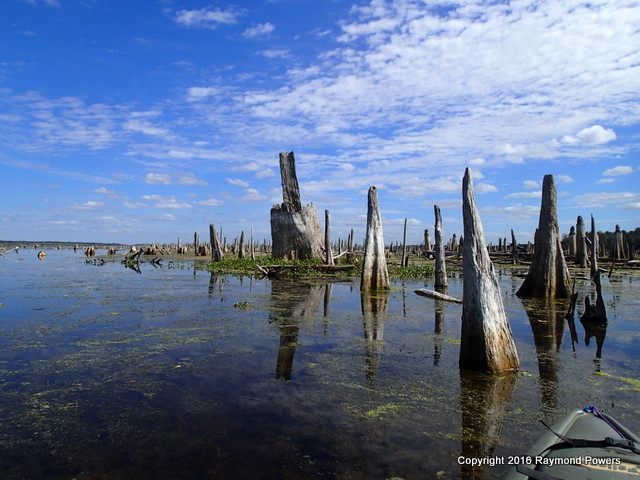
A cyclic drawdown of the large and artificial Rodman Reservoir had exposed both the old river path and the stumps of a forest long gone.

The machine in the photo above (a photo from Google images) is "The Crusher"... or "The Monster" ... 300 tons of forest smashing steel. It was much bigger than it appears in that distant photo. On Google, there is a photo of a girl standing at the foot of it for scale ... go seek it out.

The machine was built for the express purpose of both knocking down the river floodplain forest and smashing the trees into the ground so securely that they would just stay there and rot when Rodman was flooded by the dam.

Plans look so sparkly on a drawing board, don't they?

Once the forest was flattened and the river backed up behind the new dam, the trees began popping up until Rodman Reservoir was a minefield of floating logs.

This made boating in the reservoir a risky proposition for a long time and even today, logs still create navigation challenges.


So, while on one side of the barge canal, the ghost forest exists as vertical, broken, but still rooted stumps like we've seen in the earlier posts, ...on the other side all the trees are angled or horizontal.

Even with 7 more feet of water above this area at "full pool", plenty of these logs could be an issue for motorized boats.

Rodman is also heavy with exotic, invasive aquatic plants like hydrilla, and water hyacinths among the Crusher smashed logs.
They contribute vast amounts of organic matter to the reservoir which creates much of the black muck on the bottom.

But what about this strange crushed side of the canal?

The flattened side of the barge canal was very shallow due to the drawdown so even in a kayak, I found myself constantly steering around submerged logs, hyacinth clogs, and dead ends.


There were beaucoup grackles perching, flitting, and hunting "things" down among the floating hyacinths.
I know they're just grackles, but I like their personality and sleekness.
They were good company.
I'm a fan of anhingas too and this one let me drift pretty close before lifting off.


The crushed forest.


Looking out over it, I pause and drain the water with my imagination, let ... or better yet ... help the forest come back with some good restoration plans, and imagine ahead a hundred years to a restored Oklawaha with a maturing forest where now there are only dead stumps.


I'm not sure the long view is very popular right now in an era of instant gratification and over development. 
I know this, we would have no Yellowstone or Everglades today if folks in the past had not taken the long term view long ago.
Folks in the late 1800's, fighting to establish National Parks ... they were thinking of me before my grandparents were born.
Question is ... do we still do that?

Thing is, I don't want my future great-grandchildren to see the lower Oklawaha like it is now with an artificial eutrophying Rodman Reservoir.

I want them to see the springs buried beneath this artificial lake and a mature cypress forest outlining the curving path of the Oklawaha River.

And yeah, they may have to work a little harder to catch a big bass than anglers in Rodman do today.
Fish in a river are not a captive audience.
I'm okay with that.

There will still be plenty of fish with a free river, as there is today in the flowing Oklawaha upstream from Rodman.

And there will still be awesome critters like the banded watersnake below.

He kept popping up to breathe while I was parked, imagining the dam gone and the river system restoring itself.


The first time he popped up, I thought, "Dang it, I missed him!"

I sat for a bit, and in a minute or two he popped up again ... and I missed him again.
So, I let the kayak drift a little closer to the sunken log that he seemed to be working for crayfish or other tasties.

And ... Bazinga!
There he was.
Gotcha!

I like this last photo of episode 3, because it's a nice little sandwich of the crushed forest bog clog side, the barge canal with a bass boat zooming through, the stump forest on the Oklawaha channel side, and, last but not least, the upland forest beyond.

In the final episode of Rodman Exposed, I chase the Eagle.

Sunday, February 28, 2016

Rodman Reservoir EXPOSED! A Water Level View


Before we get to this ...


...or this, 
...we should have a history lesson on the "Cross Florida Barge Canal".

I'll make it brief, not like that Art History course you slept through took in college.

Depending on your source, the idea for a ship canal cutting through North Central Florida and connecting the Gulf to the Atlantic goes all the way back to colonial times.
All we need to know for this post is that after many false starts, the canal project actually got going in the 1960's with a ceremonial dynamite blast by then President Johnson.


The canal plan was to use existing natural waterways like the St.Johns River and connect them with man made canals. This would also require the construction of locks and dams...all pretty standard barge canal construction stuff.

In 1971, after much lobbying by people concerned that the canal would threaten both Florida's aquifer and ecology, the "Cross-Florida Barge Canal" project was killed by ...(you may find this surprising) ... Richard Nixon.

By that time miles of canal and several locks, had been constructed and the beautiful, wild Oklawaha River had been dammed creating Rodman Reservoir. Rodman would supply water to keep the canal depth consistent for barge travel.

There, that's the history snapshot. I'll sneak in little tidbits along the way as needed.

Strangled by the dam, the Oklawaha slowed and began flooding springs and thousands of acres of cypress wetlands.
As the river backed up behind the dam, a forest-river ecosystem died and a stick filled artificial impoundment was born.


These cypress forests exist today as weather beaten stumps and snags… a silent testimony to the forest that was... and may be again.

For the record, if you haven't sniffed this out by now, I am staunchly "anti-dam".  This is a controversial subject and I'm not going to engage in any back and forth debates in the comment section with people who take the "save the dam" tack.


This is my blog, and you get my opinions when I opinionate, which I intend to do in this series of posts.
If you don't like it, get your own dam blog.


This post and a few to follow describe a day spent paddling around in the old Oklawaha River channel.  Keep in mind thatthe area I explored is usually under about 7 feet of water.
Rodman Reservoir has slowly been drained of much of its water over the past few months by the FWC.

Drawdowns like this can rejuvenate a lake by exposing the lake bottom to the air and Sun.  
Exposure reduces the thick black oozy muck that accumulates on the bottom over time. The muck has the consistency of pudding and from what I experienced, several feet deep in many areas.
Once exposed, it dries in the sun which greatly reduces the muck volume. Some of it oxidizes with the air, some simply blows away as dust, and some is utilized by the rapidly growing pioneer plant species that grow during those 3 months of drawdown.

Muck like that robs oxygen from the water as the organics decay, smothers submerged plants, and prevents spawning by fish like Largemouth Bass, Bluegills, Redear Sunfish, etc.
Those fish need a sandy bottom where they can fan out a dish-shaped nest to lay their eggs in.


This is where I spent most of my time.
The canal itself was pretty busy with bassboats zooming off for a day of fishing, and let's face it, canals are generally not really interesting ... the whole straight and narrow thing is pretty boring.


So, let's get started ...

Next Rodman post: Life among the dead.